
INTEGRATED IT ISO CERTIFICATION:
ISO 27001, ISO 27701 & ISO 20000-1
Integrated Management System
Integrated IT ISO Certification
Integrated IT ISO certification brings information security, privacy, and IT service management into one coordinated system, helping organizations protect data, meet client expectations, reduce duplicated work, and build trust across global markets.
Digital businesses face connected risks. A security weakness can expose personal data. Poor service management can delay incident response. Inconsistent records can make an audit harder than it needs to be. Treating these issues as separate projects often creates duplicate policies, repeated meetings, and confusion over ownership.
An integrated approach connects the controls, people, records, risks, and review process behind ISO 27001, ISO 27701, and ISO 20000-1 certification. ISO/IEC 27001:2022 sets requirements for an information security management system built around risk management. ISO’s standard overview explains its application across organizations of every size and sector. ISO/IEC 27701:2025 addresses privacy information management for organizations that process personally identifiable information, while ISO/IEC 20000-1:2018 covers the planning, delivery, and continual improvement of IT services. ISO 27701 and ISO 20000-1 provide the current standard details.
For a software company, managed-service provider, cloud operator, fintech, healthcare platform, or IT department, integration creates one practical management structure. One leadership review can assess security, privacy, and service risks. One internal audit programme can test shared processes. One training plan can improve staff competence across all three areas.

Why an Integrated Approach Matters
Information security protects the confidentiality, integrity, and availability of valuable information. Privacy management focuses on responsible personal-data processing. Service management ensures that IT services are designed, delivered, measured, and improved in a controlled way.
These subjects overlap in daily work. An employee who receives a customer-data request needs clear privacy rules. The same employee may need access-control rules and a service-desk process. A cyber incident needs security containment, privacy assessment, customer communication, and service restoration. An integrated management system makes these handoffs clear before a problem occurs.
Instead of maintaining three separate document sets, organizations can create shared governance for:
- Context, scope, and interested parties
- Leadership roles and responsibilities
- Risk assessment and treatment
- Competence, awareness, and training
- Document control and evidence management
- Internal audits, corrective actions, and management reviews
- Continual improvement and performance measurement
This does not mean every control is identical. It means common processes are designed once, then tailored to each standard’s specific needs.
Benefits for IT Organizations
ISO 27001, ISO 27701, and ISO 20000-1 certification can deliver clear business benefits when the system is properly implemented and maintained.
Area | Practical benefit |
Information security | Helps identify, assess, and treat security risks before they become serious business incidents. |
Privacy | Builds a disciplined approach to personal-data handling, roles, supplier oversight, retention, and data-subject needs. |
IT service delivery | Improves service design, incident handling, change control, availability, and customer confidence. |
Sales and tenders | Gives buyers stronger evidence that the organization manages data and IT services in a structured manner. |
Efficiency | Reduces repeated policies, duplicate audits, and overlapping training across separate management systems. |
Leadership control | Gives management a single view of risks, objectives, audit results, corrective actions, and improvement priorities. |
Trust | Supports confidence among clients, partners, regulators, employees, and investors. |
Certification is not a one-time paperwork exercise. It should reflect how the organization actually works. Policies must link to real decisions. Procedures must suit real teams. Evidence must show that controls are followed, reviewed, and improved.
How Global Standards Certification Supports the Journey
Global Standards Certification can assist organizations through the fastest practical and easiest structured route to readiness. Its role is to turn complex requirements into workable actions that fit the client’s people, systems, services, and business goals.
The work begins with a gap assessment. This identifies what already exists, what is missing, and which controls deserve priority. The team then develops an integrated roadmap, simplifies documentation, trains relevant employees, supports implementation, and prepares the organization for an independent certification audit.
A responsible consultancy does not promise or issue certification itself; that decision belongs to an independent certification body. However, Global Standards Certification can help clients become audit-ready by building a system that is clear, usable, and supported by objective evidence.
Global Standards Certification effort | What it delivers |
Scope and readiness review | A clear view of services, locations, information assets, personal-data processing, and audit boundaries. |
Integrated gap assessment | A prioritized action plan covering security, privacy, service management, and shared system requirements. |
Risk and control design | Practical risk registers, treatment plans, privacy controls, service controls, and ownership assignments. |
Documentation support | Policies, procedures, registers, templates, and records designed for real operational use. |
Training and awareness | Role-based sessions for leaders, technical teams, service desks, HR, procurement, and internal auditors. |
Implementation coaching | Ongoing guidance to embed controls in daily work rather than leaving them as unused documents. |
Internal audit and review | Audit preparation, findings support, corrective-action tracking, and management-review facilitation. |
Certification support | Help with audit planning, evidence preparation, and closure of nonconformities where needed. |
Regional Service Scale
Middle East:
Global Standards Certification supports IT companies, cloud providers, government suppliers, financial-service firms, and fast-growing digital businesses across the Middle East. Engagements can be shaped around regional client expectations, cross-border operations, third-party risk, and the need to show reliable control of customer and employee data.
America:
For organisations serving North, Central, and South American markets, the service model supports mature IT operations, global outsourcing teams, SaaS platforms, and enterprise procurement demands. The integrated approach helps align security, privacy, and service performance with the evidence buyers and partners often expect during supplier due diligence.
Asia: Across Asia, technology firms frequently scale quickly across different locations, languages, and service teams. Global Standards Certification can help create a consistent integrated management system that gives leadership a common framework while allowing local teams to follow clear, workable processes.
Europe:
European-facing businesses often need strong privacy accountability, dependable service delivery, and transparent supplier management. Global Standards Certification can help organisations document these practices, build strong privacy operations, and prepare for customer, partner, or certification audits with confidence.
Reported Sector Results
Global Standards Certification reports the following client outcomes. Results reflect the stated project cases; final certification decisions remain with an independent certification body.
Sector and client | Integrated actions completed | Reported result |
Software House: Workstream Automation (Integrated Certification in 3 Months) | • Deployed integrated, role-based access management and privacy-by-design practices. | Achieved integrated ISO 27001, ISO 27701, and ISO 20000-1 certification in three months. The organization reported a 75% stronger ISMS, documented privacy controls, and a 40% reduction in service incidents. |
Digital Services: Outsource In (Integrated Certification in 21 Days) | • Completed a pre-audit vulnerability scan and integrated privacy assessment. | Achieved full integrated certification across the three standards in 21 days, reportedly more than 70% faster than typical industry timelines. |
Hardware & Software: Ora-Tech Technologies (60% to 25% Vulnerabilities in 2 Months) | • Implemented MFA and encryption across systems. | Reduced reported vulnerabilities from 60% to 25% in two months, achieved integrated certification, and reduced service downtime by 50%. |
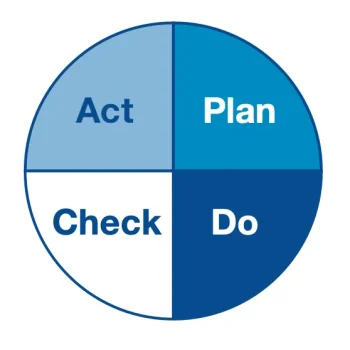
PDCA Model for Integrated Management Systems
The Plan-Do-Check-Act cycle applies across all three standards, enabling continuous improvement of security, privacy, and service management.
1. Plan – Unified Strategy Development
Before implementing controls, organizations identify risks across all dimensions and define integrated objectives.
Integrated Risk Assessments
- Pinpoint vulnerabilities in Confidentiality, Integrity, Availability (CIA) for data and services
- Identify privacy risks across personal data lifecycle
- Map service continuity risks and dependencies
Unified Risk Register
- Maintain a single repository of risks connected to services, assets, and PII processing
- Link DPIA requirements to privacy risk management
Integrated Policy Development
- Create overarching IMS policy with appendices for ITSM, ISMS, and PIMS
- Develop unified procedures for incident, change, and supplier management
2. Do – Unified Implementation
With a shared plan in place, organizations deploy integrated controls.
Unified Control Integration
- Deploy encryption, access management, monitoring tools, and service management processes
- Implement incident management covering service, security, and data breach events
- Establish change management with security and privacy reviews
Cross-Functional Training
- Train all staff on unified service, security, and privacy protocols
- Provide specialized training for roles handling PII and critical services
Integrated Documentation
- Maintain single audit-ready documentation repository covering all standards
3. Check – Unified Monitoring & Auditing
Security, privacy, and service delivery are not static—regular checks ensure continued effectiveness.
Integrated Internal Audits
- Identify gaps across all standards before external assessments
- Test interconnections between service, security, and privacy controls
Unified Performance Reviews
- Measure IMS effectiveness against integrated KPIs
- Track service, security, and privacy metrics in a single dashboard
Compliance Testing
- Verify adherence to ISO 27001 certification, ISO 27701, and ISO 20000-1 requirements
4. Act – Integrated Refinement
The final phase turns insights into unified action.
Address Non-Conformities
- Correct weaknesses found in integrated audits
- Implement root cause analysis across all three domains
Update Unified Policies
- Adapt to new threats, regulatory changes, or business requirements
Plan Future Upgrades
- Keep the integrated management system ahead of emerging risks
- Maintain certification while continuously strengthening security, privacy, and service delivery
Applicable Clauses for
Implementation
Standard | Key Clauses for Integration |
ISO 27001:2022 | Context of Organization, Leadership, Planning, Support, Operation, Performance Evaluation, Improvement |
ISO 27701:2019 | Extension to ISO 27001, PIMS-specific requirements for PII controllers and processors, Privacy Principles, Roles of Controllers and Processors, PII Handling Requirements |
ISO 20000-1:2018 | Service Management System, Governance, Service Planning, Service Delivery, Service Relationship, Incident & Service Request, Change Management, Service Continuity |
All standards follow the ISO Annex SL High-Level Structure, enabling seamless integration of leadership, planning, support, operation, performance evaluation, and improvement clauses.
Tentative Timeline and Project Price for Integrated IT ISO certification
Tentative Project Timeline (2 to 6 Month Baseline)
| Phase | Duration | Core activities |
|---|---|---|
| 1. Gap Analysis & Planning | Weeks 1–3 | Baseline assessment against ISO 27001, ISO 27701, and ISO 20000-1 requirements; define certification scope, services, locations, information assets, personal-data processing, and project team. |
| 2. Integrated System & Document Setup | Weeks 4–10 | Develop integrated policies, risk registers, privacy controls, asset registers, service-management procedures, incident processes, change management, SLAs, and required templates. |
| 3. Implementation & Training | Weeks 11–16 | Deploy security, privacy, and IT service controls; conduct awareness sessions, secure-coding or technical training where needed, and create operational evidence. |
| 4. Internal Audit & Management Review | Weeks 17–20 | Train internal auditors, complete integrated internal audits, close findings, measure performance, and conduct management review. |
| 5. Certification Audits | Weeks 21–26 | Stage 1: Document review and readiness assessment. Stage 2: Operational audit, evidence review, and certification decision by the independent certification body. |
Note: The time between Stage 1 and Stage 2 depends on the certification body, audit findings, and readiness. A 30-day gap is often planned to address preliminary observations.
Price Breakdown Estimates
Total project costs fall into two separate categories: Consultancy and implementation support and certification-body audit fees.
| Company size | Employee count | Consultancy & setup | Certification-body audit fees | Estimated total |
|---|---|---|---|---|
| Small | 1–25 employees | PKR 250,000–500,000 | PKR 250,000–450,000 | PKR 500,000–950,000 |
| Medium | 26–100 employees | PKR 500,000–900,000 | PKR 450,000–750,000 | PKR 950,000–1,650,000 |
| Large / Multi-site | 100+ employees | PKR 900,000–1,800,000 | PKR 750,000–1,500,000 | PKR 1,650,000–3,300,000 |
What Consultancy Covers
| Consultancy service | Included support |
|---|---|
| Gap analysis | Existing-system review and integrated implementation roadmap |
| Documentation | Policies, procedures, registers, risk assessments, privacy records, and IT service-management documents |
| Training | Employee awareness, role-based training, and internal-auditor training |
| Implementation | Support for security controls, privacy processes, incident management, change management, and service-level management |
| Audit readiness | Internal audit, corrective-action support, management review, and certification-audit preparation |
Key Cost Factors
- Scope and locations: A single-site software company normally requires fewer audit days than a multi-site managed-service provider.
- Service complexity: More IT services, cloud platforms, suppliers, and customer data flows increase the required effort.
- Current maturity: Existing security, privacy, and IT service controls can reduce both time and consultancy cost.
- Internal capability: Using internal staff for documentation and implementation can lower consultancy fees.
- Surveillance audits: Plan approximately 30–40% of the initial certification audit fee each year for Year 1 and Year 2 surveillance audits.
Disclaimer: These estimates are indicative only. Final pricing varies according to employee count, locations, service scope, business complexity, existing controls, audit duration, and the selected independent certification body.
Flexible Certification Options
It is important to note that, while we highly recommend the integrated approach for its maximum synergy and efficiency, we fully understand that not every organization is ready to embark on a full IMS journey at once. Accordingly, Global Standards provides the flexibility to pursue each certification individually whether you require ISO 27001 certification for information security management, ISO 27701 for privacy information management, or ISO 20000-1 for IT service management. This modular pathway enables you to strengthen your information security, privacy, and service management systems progressively, at a pace that aligns with your operational capacity, budgetary considerations, and strategic goals, while still benefiting from our expert guidance every step of the way.
Why Clients Trust Global Standards
Our clients consistently praise our efficiency and expertise. Google reviews and website testimonials highlight:
- Faster certification without compromising quality.
- Clear, jargon-free guidance at every step.
- Ongoing support post-certification.
One client stated:
“Global Standards got us certified in weeks, not months. Their team made compliance effortless.”
FAQs
What is Integrated IT ISO certification?
Integrated IT ISO certification combines information security (ISO 27001), privacy (ISO 27701), and IT service management (ISO 20000-1) into a single coordinated system to protect data, meet client expectations, reduce duplicated work, and build trust.
What standards are included in this Integrated Management System (IMS)?
The system integrates ISO/IEC 27001:2022 (Information Security Management System), ISO/IEC 27701:2025 (Privacy Information Management System), and ISO/IEC 20000-1:2018 (IT Service Management System).
What are the primary business benefits of an integrated approach?
Key benefits include identifying and treating security risks before incidents occur, establishing disciplined personal-data handling, improving service delivery and incident response, providing stronger evidence during sales and tenders, and reducing duplicate policies, audits, and training.
How long does the implementation and certification process take?
The baseline project timeline generally ranges from 2 to 6 months across five main phases: Gap Analysis & Planning (Weeks 1–3), System & Document Setup (Weeks 4–10), Implementation & Training (Weeks 11–16), Internal Audit & Management Review (Weeks 17–20), and Certification Audits (Weeks 21–26).
How much does Integrated IT ISO certification cost?
Estimated total project costs (combining consultancy and audit fees) depend on company size:
- Small (1–25 employees): PKR 500,000 – 950,000
- Medium (26–100 employees): PKR 950,000 – 1,650,000
- Large / Multi-site (100+ employees): PKR 1,650,000 – 3,300,000
Can an organization pursue these ISO certifications individually?
Yes. While an integrated approach is recommended for maximum synergy, organizations can pursue ISO 27001, ISO 27701, or ISO 20000-1 individually in a modular pathway that aligns with their operational capacity and budget.
Does Global Standards Certification issue the final ISO certificate?
No. Global Standards Certification provides gap assessments, documentation, training, and implementation support to make organizations audit-ready. The final certification decision is made by an independent certification body.
Phone:
General Landline: +92-21-32534937
Business Development: +92-306-2708496
Operations & Support: +92-308-2255440
Emails:
info@globalstandards.com.pk
business.dev@globalstandards.com.pk
training@globalstandards.com.pk
operation@globalstandards.com.pk
jobs@globalstandards.com.pk