
THE INTEGRATION CERTIFICATION OF
ISO 27001, ISO 27701, ISO 42001 & ISO 20000-1
Integrated Management System
Information Security Certification
Information Security Certification brings information security, data privacy, IT service delivery, and artificial intelligence governance into one coordinated management system. By unifying ISO 27001, ISO 27701, ISO 20000-1, and ISO 42001, digital enterprises can safeguard business data, protect personal information, maintain service excellence, and deploy responsible AI solutions under a single, efficient operational framework.
Modern technology organizations face complex, interconnected risks. An unmanaged AI model can leak sensitive proprietary data or personal records, a technical security flaw can trigger a privacy breach, and disjointed service processes can delay critical incident response times. Treating these areas as isolated projects creates duplicate policies, redundant meetings, overlapping audits, and internal confusion.
An integrated approach connects the controls, roles, risks, and review processes across all four global standards under the common ISO Annex SL (High-Level Structure) framework. Whether you operate a software enterprise, managed service provider (MSP), cloud platform, fintech, AI startup, or IT department, integration creates one practical, audit-ready management system.

The Four Core Standards Included
ISO/IEC 27001:2022 (Information Security Management System – ISMS):
Sets standard requirements for identifying, evaluating, and managing information security risks to protect asset confidentiality, integrity, and availability (CIA).
ISO/IEC 27701:2025 (Privacy Information Management System – PIMS):
Extends ISO 27001 to manage personal data (PII) responsibly, ensuring compliance for both PII Controllers and PII Processors.
ISO/IEC 20000-1:2018 (IT Service Management System – ITSM):
Establishes requirements for planning, delivering, operating, and continuously improving IT services, service desks, and customer support functions.
ISO/IEC 42001:2023 (Artificial Intelligence Management System – AIMS):
Provides the global benchmark for responsible development, deployment, and usage of AI systems, addressing AI ethics, data quality, algorithmic transparency, and model risks.
Key Benefits for IT & Tech Organizations
Combining these standards delivers clear operational, regulatory, and competitive advantages:
| Area | Core Standard | Key Practical Benefit |
| Information Security | ISO 27001 | Mitigates cybersecurity threats, prevents data leaks, and secures business assets. |
| Privacy Management | ISO 27701 | Ensures compliant handling of personal data (PII), handling privacy requests and cross-border requirements. |
| IT Service Delivery | ISO 20000-1 | Enhances service desk response, SLA performance, change management, and service continuity. |
| Responsible AI Governance | ISO 42001 | Mitigates AI system bias, ensures algorithmic safety, manages AI data training risks, and builds client trust. |
| Sales & Tenders | All Standards | Provides strong evidence during vendor due diligence, enabling faster deal closures with international buyers. |
| Operational Efficiency | Integrated Approach | Eliminates duplicate policies, aligns internal audits, and reduces managerial workload across teams. |
How Global Standards Certification Supports the Journey
Global Standards assists tech companies through a structured, fastest practical path to audit readiness:
Consultancy Support Stage | Deliverable / Outcome |
Scope & Readiness Review | Defines project boundaries across services, systems, data flows, and AI models. |
Integrated Gap Assessment | Delivers a prioritized action plan covering ISO 27001, ISO 27701, ISO 20000-1, and ISO 42001. |
Risk & Control Design | Creates unified risk registers, privacy impact assessments (DPIA), SLAs, and AI impact assessments. |
Documentation Development | Prepares clear, usable policies, SOPs, registers, and operational templates tailored to your workflow. |
Training & Capability Building | Delivers role-based sessions for developers, AI engineers, service desk staff, and internal auditors. |
Implementation Coaching | Provides ongoing support to embed operational controls into daily work rather than unused files. |
Internal Audit & Management Review | Conducts full pre-certification audits, tracks corrective actions, and facilitates management reviews. |
Certification Audit Support | Coordinates evidence preparation and assists during external certification body audits. |
Regional Service Scale
Middle East
Supporting technology providers, government vendors, financial platforms, and SaaS platforms across the region to meet data residency, service quality, and responsible AI compliance.
America
Assisting SaaS platforms, IT outsourcing firms, and digital enterprises facing rigorous enterprise supplier due diligence, SOC/ISO alignments, and AI regulatory expectations.
Asia
Helping fast-scaling tech hubs, software engineering firms, and IT services providers implement structured governance to support rapid international expansion.
Europe
Enabling export-oriented software, cloud, and digital service firms to satisfy stringent data privacy frameworks, service commitments, and AI governance mandates.
Reported Sector Results
Global Standards Certification reports the following client outcomes. Results reflect the stated project cases; final certification decisions remain with an independent certification body.
Sector and client | Integrated actions completed | Reported result |
Software House: Workstream Automation (Integrated Certification in 3 Months) | • Deployed integrated, role-based access management and privacy-by-design practices. | Achieved integrated ISO 27001, ISO 27701, and ISO 20000-1 certification in three months. The organization reported a 75% stronger ISMS, documented privacy controls, and a 40% reduction in service incidents. |
Digital Services: Outsource In (Integrated Certification in 21 Days) | • Completed a pre-audit vulnerability scan and integrated privacy assessment. | Achieved full integrated certification across the three standards in 21 days, reportedly more than 70% faster than typical industry timelines. |
Hardware & Software: Ora-Tech Technologies (60% to 25% Vulnerabilities in 2 Months) | • Implemented MFA and encryption across systems. | Reduced reported vulnerabilities from 60% to 25% in two months, achieved integrated certification, and reduced service downtime by 50%. |
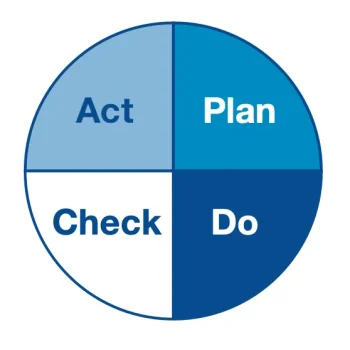
PDCA Model for Integrated Management Systems
The Plan-Do-Check-Act (PDCA) cycle drives continuous improvement across security, privacy, IT service delivery, and AI governance:
1. Plan: Strategy & Risk Assessment
- Integrated Risk Evaluations: Analyze information security risks (ISO 27001), personal data lifecycle risks (ISO 27701), service delivery disruptions (ISO 20000-1), and AI-specific risks such as bias, hallucination, data quality, and model failure (ISO 42001).
- Unified Policy Architecture: Develop an overarching IMS policy supported by clear operational procedures for security, privacy, service management, and AI usage.
2. Do: Execution & Control Integration
- Unified Safeguards: Implement technical access controls, data encryption, incident response plans, service level targets, and ethical AI development guidelines.
- Unified Incident Management: Establish a single incident handling workflow that addresses IT downtime, security breaches, data privacy failures, and unexpected AI system behaviors.
- Role-Based Training: Educate developers, AI engineers, support teams, HR, and executives on secure coding, privacy protocols, service commitments, and AI ethics.
3. Check: Unified Monitoring & Internal Audits
- Single Internal Audit Program: Evaluate compliance across all four standards in one structured internal audit, eliminating audit fatigue.
- Performance Dashboard: Track service SLAs, security metrics, PII processing requests, and AI model performance indicators in one centralized system.
4. Act: Continuous System Refinement
- Integrated Corrective Actions (CAPA): Conduct root-cause analysis for service outages, security incidents, data breaches, or AI system anomalies.
- Policy Adaptation: Regularly update protocols to stay ahead of emerging cyber threats, privacy laws, and evolving AI technologies.
Applicable Clauses for
Implementation
| Standard | Standard Focus | Key Clauses for Integration |
| ISO 27001:2022 | Information Security | Clauses 4–10 (Context, Leadership, Planning, Support, Operation, Performance Evaluation, Improvement), Annex A Controls. |
| ISO 27701:2025 | Privacy Information Management | PIMS extensions to Clause 5–10, Controller & Processor obligations, Data Privacy Principles. |
| ISO 20000-1:2018 | IT Service Management | Service Portfolio, Relationship Management, Incident & Request Management, Service Continuity, Change Control. |
| ISO 42001:2023 | AI Management System | AI System Impact Assessment, Responsible AI Policies, Algorithmic Transparency, Model Governance, Data Quality. |
All standards follow the ISO Annex SL High-Level Structure, enabling seamless integration of leadership, planning, support, operation, performance evaluation, and improvement clauses.
Tentative Timeline and Project Price for Integrated IT ISO Certification
(ISO 27001, ISO 27701, ISO 20000-1 & ISO 42001)
Tentative Project Timeline (2 to 6 Month Baseline)
| Phase | Duration | Core Activities |
| 1. Gap Analysis & Planning | Weeks 1–3 | Baseline assessment against ISO 27001, ISO 27701, ISO 20000-1, and ISO 42001 requirements; define certification scope, IT services, locations, information assets, personal-data processing (PII), AI models/systems, and project team. |
| 2. Integrated System & Document Setup | Weeks 4–10 | Develop integrated policies, risk registers, privacy impact assessments (DPIA), AI impact assessments, asset registers, service-management procedures, incident processes, change management, SLAs, ethical AI guidelines, and required templates. |
| 3. Implementation & Training | Weeks 11–16 | Deploy security, privacy, IT service, and AI safety controls; conduct awareness sessions, secure-coding, AI ethics/model governance training, and generate operational evidence. |
| 4. Internal Audit & Management Review | Weeks 17–20 | Train internal auditors on all four standards, complete integrated internal audits, close findings, measure system KPIs, and conduct an integrated management review. |
| 5. Certification Audits | Weeks 21–26 | Stage 1: Document review, AI asset verification, and readiness assessment.
Stage 2: Operational audit, evidence review, and certification decision by the independent certification body.
(Note: A 30-day gap between Stage 1 and Stage 2 is typically planned to address preliminary observations). |
Price Breakdown Estimates
Total project costs fall into two separate categories: Consultancy & Implementation Support and Certification-Body Audit Fees.
| Company Size | Employee Count | Consultancy & Setup Fee | Certification-Body Audit Fee | Estimated Total Cost |
| Small | 1–25 employees | PKR 350,000–650,000 | PKR 350,000–550,000 | PKR 700,000–1,200,000 |
| Medium | 26–100 employees | PKR 650,000–1,100,000 | PKR 550,000–950,000 | PKR 1,200,000–2,050,000 |
| Large / Multi-site | 100+ employees | PKR 1,100,000–2,200,000 | PKR 950,000–1,800,000 | PKR 2,050,000–4,000,000 |
What Consultancy Covers
| Consultancy Service | Included Support |
| Gap Analysis | Existing-system review and integrated implementation roadmap for ISO 27001, 27701, 20000-1, and 42001. |
| Documentation | Integrated policies, SOPs, registers, risk assessments, privacy records, ITSM documents, and AI model governance controls. |
| Training | Employee awareness, role-based training (technical, privacy, AI ethics/safety), and 4-standard internal-auditor training. |
| Implementation Support | Guidance on security controls, privacy processes, incident management, service delivery, and AI risk/bias mitigation. |
| Audit Readiness | Integrated internal audit, corrective action support (CAPA), management review, and full certification-audit preparation. |
Key Cost Factors
- Scope and Locations: A single-site software team requires fewer audit days than a multi-site provider deploying complex AI infrastructure and cloud platforms.
- AI & Service Complexity: The number of IT services, custom machine learning models, cloud integrations, and sensitive data flows directly impacts audit scope.
- Current Maturity: Existing security, privacy, IT service, and data management controls significantly reduce consultancy time and overall cost.
- Internal Capability: Active involvement of internal technical, AI, and compliance staff in documentation can lower consultancy fees.
- Surveillance Audits: Plan approximately 30–40% of the initial certification audit fee annually for Year 1 and Year 2 surveillance audits.
Flexible Certification Options
It is important to note that, while we highly recommend the integrated approach for its maximum synergy and efficiency, we fully understand that not every organization is ready to embark on a full IMS journey at once. Accordingly, Global Standards provides the flexibility to pursue each certification individually whether you require ISO 27001 certification for information security management, ISO 27701 for privacy information management, or ISO 20000-1 for IT service management. This modular pathway enables you to strengthen your information security, privacy, and service management systems progressively, at a pace that aligns with your operational capacity, budgetary considerations, and strategic goals, while still benefiting from our expert guidance every step of the way.
Why Clients Trust Global Standards
Our clients consistently praise our efficiency and expertise. Google reviews and website testimonials highlight:
- Faster certification without compromising quality.
- Clear, jargon-free guidance at every step.
- Ongoing support post-certification.
One client stated:
“Global Standards got us certified in weeks, not months. Their team made compliance effortless.”
FAQs
What is Integrated IT ISO certification?
Integrated IT ISO certification combines information security (ISO 27001), privacy (ISO 27701), and IT service management (ISO 20000-1) into a single coordinated system to protect data, meet client expectations, reduce duplicated work, and build trust.
What standards are included in this Integrated Management System (IMS)?
The system integrates ISO/IEC 27001:2022 (Information Security Management System), ISO/IEC 27701:2025 (Privacy Information Management System), and ISO/IEC 20000-1:2018 (IT Service Management System).
What are the primary business benefits of an integrated approach?
Key benefits include identifying and treating security risks before incidents occur, establishing disciplined personal-data handling, improving service delivery and incident response, providing stronger evidence during sales and tenders, and reducing duplicate policies, audits, and training.
How long does the implementation and certification process take?
The baseline project timeline generally ranges from 2 to 6 months across five main phases: Gap Analysis & Planning (Weeks 1–3), System & Document Setup (Weeks 4–10), Implementation & Training (Weeks 11–16), Internal Audit & Management Review (Weeks 17–20), and Certification Audits (Weeks 21–26).
Can an organization pursue these ISO certifications individually?
Yes. While an integrated approach is recommended for maximum synergy, organizations can pursue ISO 27001, ISO 27701, or ISO 20000-1 individually in a modular pathway that aligns with their operational capacity and budget.
Does Global Standards Certification issue the final ISO certificate?
No. Global Standards Certification provides gap assessments, documentation, training, and implementation support to make organizations audit-ready. The final certification decision is made by an independent certification body.
Phone:
General Landline: +92-21-32534937
Business Development: +92-306-2708496
Operations & Support: +92-308-2255440
Emails:
info@globalstandards.com.pk
business.dev@globalstandards.com.pk
training@globalstandards.com.pk
operation@globalstandards.com.pk
jobs@globalstandards.com.pk