
ISO 45001 CERTIFICATION
ISO 45001 Occupational Health & Safety Management System Certification, Training & Auditing
ISO 45001 Certification helps organizations build a safe, lawful, and reliable workplace system that reduces injury risks, improves employee confidence, and supports stronger business growth through an internationally recognized Occupational Health and Safety Management System.
Workplace safety is no longer only a legal requirement. It is a business priority that protects people, strengthens operations, and improves client trust. ISO 45001 is the global standard for Occupational Health and Safety Management Systems, also known as OHSMS. It helps organizations identify workplace hazards, assess risks, involve workers, meet legal duties, and prevent incidents before they occur.
Organizations in engineering, construction, manufacturing, healthcare, logistics, facility management, education, and service industries are increasingly seeking ISO 45001 certification. Many clients, international partners, and public sector tenders now expect proof of a structured safety system. Certification shows that an organization has clear controls for occupational health and safety, not just verbal commitments.
Global Standards Certification can fully assist companies through the fastest and easiest practical route to certification. Its approach combines gap assessment, documentation support, employee training, implementation guidance, internal auditing, and certification readiness. The focus is to build a workable system that suits the organization’s actual operations, workforce, hazards, and goals.

Why ISO 45001 Matters for Your Organizations
Diverse industrial landscape. Workers may face risks from heavy machinery, electrical systems, working at height, chemicals, fire, vehicle movement, poor ergonomics, noise, dust, and unsafe contractor practices. These risks can cause injuries, project delays, legal exposure, financial loss, and damage to reputation.
ISO 45001 gives leaders a structured way to manage these issues. It requires top management involvement, clear safety roles, worker consultation, hazard identification, risk control, emergency planning, incident investigation, and ongoing improvement.
The standard also encourages businesses to move beyond reactive safety practices. Instead of only responding after an accident, organizations can identify weak controls early and correct them. This helps create a workplace where safety becomes part of daily decisions, planning, procurement, maintenance, and supervision.
For many companies, ISO 45001 Certification also supports tender eligibility and supplier approval. Large clients often prefer certified vendors because a strong safety system lowers project risk and reflects professional management.
What Are the Main Requirements of ISO 45001?
ISO 45001 does not impose one fixed safety program on every business. It provides a flexible framework that can be adjusted for a small office, a factory, a construction site, or a large multi site organization.
A successful system normally includes:
- A clear occupational health and safety policy approved by leadership.
- Identification of hazards in routine and non routine activities.
- Risk assessment and practical control measures.
- Legal and regulatory compliance monitoring.
- Employee consultation and participation.
- Safety objectives, training plans, and competence records.
- Emergency response arrangements.
- Incident reporting and investigation.
- Internal audits and management review meetings.
- Corrective actions and continual improvement.
The key strength of the standard is its focus on worker participation. Employees often understand site risks better than anyone else. Their feedback can help management find unsafe conditions, weak work methods, or gaps in training before those issues cause harm.
What Benefits Does ISO 45001 Offer Businesses?
ISO 45001 provides measurable value when it is properly implemented and maintained.
- It reduces workplace incidents by improving hazard control.
- It creates stronger employee confidence and engagement.
- It supports compliance with applicable health and safety laws.
- It improves tender opportunities and customer confidence.
- It reduces costs linked to injuries, lost time, rework, and disruption.
- It improves emergency readiness and incident response.
- It strengthens contractor and supplier safety controls.
- It supports a better organizational reputation.
- It gives leaders reliable safety data for better decisions.
- It promotes continual improvement rather than one time compliance.
Certification is especially valuable for companies working with international clients. It gives buyers and partners confidence that safety is managed through a recognized global framework.
How Global Standards Certification Supports Clients
Global Standards Certification helps organizations create an OHSMS that is practical, clear, and ready for independent certification. The team begins by reviewing existing safety practices, documents, legal duties, site conditions, and business risks. From there, it prepares a focused implementation plan.
The service can include policy development, risk registers, legal registers, safety procedures, emergency plans, training matrices, audit checklists, and management review support. It also helps employees understand their responsibilities, because documents alone cannot create a safe workplace.
The goal is not to burden a company with unnecessary paperwork. The goal is to create useful controls that employees can follow every day. This makes the certification journey simpler, faster, and more sustainable.
What Proven Results Has Global Standards Certification Delivered?
Global Standards Certification reports 100% successful results for the supported sectors listed below, based on the completion of agreed project scopes and certification readiness objectives.
Sector and Client | Global Standards Certification Efforts | Reported Result |
Engineering Sector: SAS Corporation | Reviewed environmental and operational practices, delivered employee education, developed practical guidelines, and improved management controls for waste reduction and staff competence. | SAS Corporation improved its environmental system and employee competence, transforming its management system to generate less waste. |
Construction Sector: Techno Consult International (Pvt.) Ltd. | Provided QHSE consultation, environment friendly policies, leadership support, workforce training, and implementation monitoring for four months. | The organization improved up to 70% against emissions through focused policies and training. |
Facility Management Sector: Mega Facility Management | Delivered OHSMS training, consultation, internal auditing, QHSE improvement guidance, and action planning for waste and energy issues. | The organization achieved up to 50% progressive QHSE improvement to address waste generation and energy consumption. |
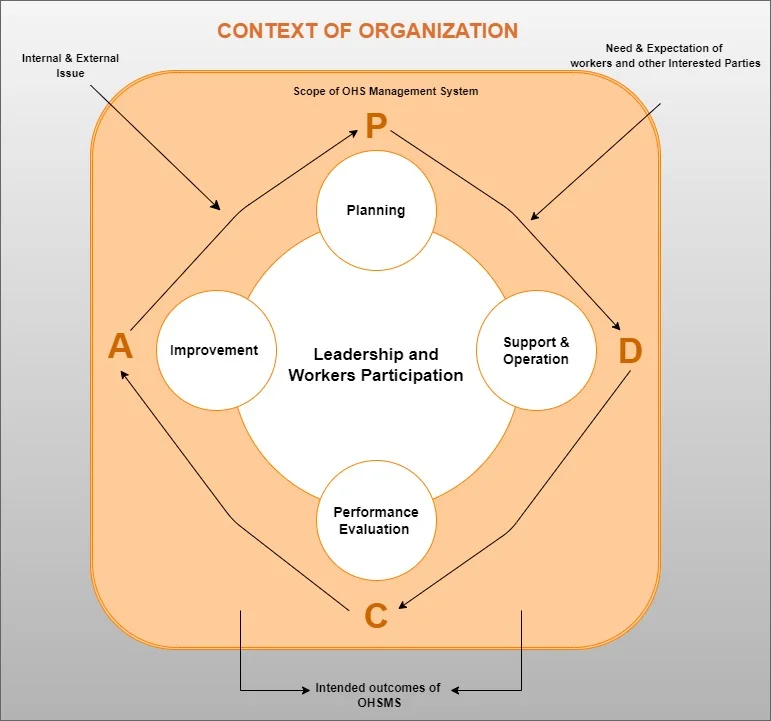
What is the New Methodology Of PDCA Model
ISO 45001 adopts Annex SL’s high-level structure (HLS), creating a unified framework for all ISO management system standards. As a result, this approach delivers three key benefits, just like other ISO standards. First, it ensures consistency across different standards. Second, it perfectly aligns occupational health and safety (OHS) management systems with other ISO frameworks. Third, it harmonizes sub-clauses and terminology across all standards for Health & safety certification.
Consequently, organizations can integrate multiple systems seamlessly while reducing compliance complexity. Moreover, businesses now find it easier to implement, maintain, and audit their management systems more efficiently than ever before. Ultimately, this streamlined approach supports stronger safety performance and continuous improvement.
Applicable Clauses for the Implementation
- Context of Organization
- Leadership
- Planning
- Support
- Operation
- Perfomance Evaluation
- Improvement
What Is the Tentative Timeline and Price for the Project?
The following prices are indicative and may vary by workforce size, number of locations, business complexity, current documentation, and certification body charges.
Project Scope | Tentative Timeline | Indicative Consulting Price |
Small organization, one site, up to 25 employees | 4 to 6 weeks | PKR 180,000 to PKR 300,000 |
Medium organization, one to three sites, up to 100 employees | 6 to 10 weeks | PKR 350,000 to PKR 650,000 |
Large or high risk organization with multiple sites | 10 to 16 weeks | PKR 700,000 to PKR 1,500,000 |
Certification audit support and closure of audit findings | 1 to 3 weeks | PKR 100,000 to PKR 250,000 |
Certification body audit fees are normally separate from consulting charges. A detailed quotation should follow an initial assessment of the organization’s scope, locations, workforce, activities, and risk level.
Why Should Your Organization Pursue ISO 45001 Today?
ISO 45001 Certification in Pakistan is a valuable investment for organizations that want safer workplaces, stronger business credibility, and better control of operational risk. It gives companies a clear structure for preventing injuries, engaging workers, meeting client expectations, and improving safety performance over time.
With expert support from Global Standards Certification, organizations can move from basic safety practices to a recognized and effective ISO 45001. Through practical guidance, training, auditing, and certification readiness support, companies can achieve ISO 45001 certification with confidence and build a safer future for their people and operations.
FAQ’s
What is ISO 45001 certification?
ISO 45001 is the international standard for Occupational Health and Safety Management Systems (OHSMS). It provides a framework for organizations to identify workplace hazards, assess risks, meet legal requirements, and prevent work-related injuries and illnesses.
What are the primary benefits of ISO 45001 for a business?
Implementing ISO 45001 reduces workplace incidents, improves regulatory compliance, strengthens worker confidence, lowers injury-related costs, and enhances tender eligibility and reputation with domestic and international clients.
What key elements are required to implement ISO 45001?
A compliant OHSMS requires leadership commitment, worker consultation, hazard identification, risk controls, legal compliance monitoring, emergency response plans, incident investigations, internal audits, and continual improvement initiatives.
How does the PDCA / High-Level Structure work in ISO 45001?
ISO 45001 follows the standard Annex SL High-Level Structure based on the Plan-Do-Check-Act (PDCA) model. This aligns occupational safety clauses (Context, Leadership, Planning, Support, Operation, Performance Evaluation, and Improvement) with other ISO standards like ISO 9001 or ISO 14001 for seamless integration.
How much does ISO 45001 consulting cost and how long does implementation take?
Timelines and pricing depend on organization size and complexity:
- Small (up to 25 employees): 4–6 weeks | PKR 180,000–300,000
- Medium (up to 100 employees): 6–10 weeks | PKR 350,000–650,000
- Large / High-risk / Multi-site: 10–16 weeks | PKR 700,000–1,500,000 (Note: Certification body audit fees are billed separately from consulting fees).
Phone:
General Landline: +92-21-32534937
Business Development: +92-306-2708496
Operations & Support: +92-308-2255440
Emails:
info@globalstandards.com.pk
business.dev@globalstandards.com.pk
training@globalstandards.com.pk
operation@globalstandards.com.pk
jobs@globalstandards.com.pk