
ISO 27001 CERTIFICATION
ISO 27001 Information Security Management System Certification, Training & Auditing
ISO 27001 Certification helps organizations protect sensitive information, manage security risks, meet client requirements, and prove that their Information Security Management System is effective. It gives businesses a clear, auditable system for security controls, employee awareness, risk management, and continual improvement.
Software houses, digital agencies, manufacturers, healthcare providers, educational institutions, and financial service firms handle valuable information every day. Client records, employee data, source code, cloud accounts, payment details, and business plans need proper protection.
ISO 27001 is the global standard for an Information Security Management System, also called ISMS. It helps an organization identify risks, select security controls, train employees, monitor performance, and improve its system over time.
Security is no longer only an IT issue. A weak password process, untrained employee, missing backup, uncontrolled vendor, or unclear incident response process can damage the whole business. ISO 27001 connects these areas through one managed system.
For businesses serving overseas clients, certification has strong commercial value. Many buyers ask suppliers to prove how they protect confidential information before awarding contracts. A recognized certificate helps reduce concerns during vendor assessments and tender processes.

Why ISO 27001 Matters
Cybersecurity is no longer only an IT issue. A weak password process, an untrained employee, a missing backup, an uncontrolled vendor, or an unclear response plan can disrupt the entire business. ISO 27001 connects these areas through a single management system.
The standard requires an organization to understand its business context, identify interested parties, define the scope of the ISMS, assess information security risks, select suitable controls, and measure results. It also creates a regular cycle of review. Leaders make security decisions using evidence rather than assumptions.
This matters in Pakistan because many organizations serve overseas customers. A business may have strong technical talent but still lose work if it cannot demonstrate control over information security. ISO 27001 gives customers a recognized method to assess security maturity.
What Benefits Can ISO 27001 Provide?
ISO 27001 Certification in Pakistan can provide practical and commercial benefits when leadership and employees actively follow the ISMS.
- It protects confidential client, employee, and company information.
- It reduces the risk of data loss, unauthorized access, fraud, and disruption.
- It builds trust with clients, partners, investors, and regulators.
- It supports eligibility for tenders and international contracts.
- It defines security roles, approvals, and responsibilities.
- It improves employee awareness through focused training.
- It strengthens incident response, access control, backups, and vendor management.
- It helps leadership make better decisions about security risks.
- It creates a structured process for continual security improvement.
- It improves market credibility in competitive sectors.
How Does Global Standards Certification Support Certification?
Global Standards Certification assists organizations through the fastest and easiest practical route toward ISO 27001 certification. The approach starts with understanding the organization’s services, information assets, customer requirements, technology environment, and key risks.
The team conducts a gap assessment to compare existing practices with ISO 27001 requirements. It then helps develop an ISMS that fits real operations. This includes information security policies, risk assessment records, treatment plans, procedures, control evidence, internal audit reports, and management review records.
Global Standards Certification also provides employee training, consultation, audit preparation, and corrective action guidance. The goal is not simply to create documents for an audit. The goal is to build a working security system that employees understand and leaders can manage.
The service model has delivered 100% successful results across supported sectors when clients complete the agreed actions, provide evidence on time, and close identified findings before the certification audit.
What Efforts and Results Did Global Standards Certification Deliver?
Sector | Organization | Efforts Used by Global Standards Certification | Reported Result |
Software House | Workstream Automation | Security guidance, employee education, ISMS planning, management system support, and practical control guidance | Improved its security system and employee competence through education and guidelines. Its management system was transformed to generate a stronger security system. |
Digital Services | Outsource In | ISMS services, security friendly policies, employee training, leadership guidance, and four months of implementation support | Reported improvement of up to 55% against its stated emissions measure through security friendly policies and training. |
Hardware and Software | Ora-Tech Technologies | ISMS training, consultation, internal auditing, corrective action guidance, and certification readiness support | Reported up to 50% progressive change in its ISMS system and security improvement activities. |
These examples show that ISO 27001 supports more than a successful audit. It can improve employee competence, strengthen security controls, provide leaders with clearer information, and create a stronger security culture.
What is the PDCA Model In ISO 27001
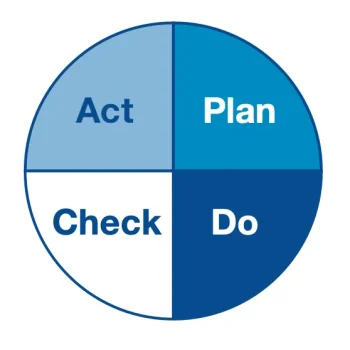
ISO 27001 certification isn’t a one-time achievement it’s an ongoing commitment to security excellence. The Plan-Do-Check-Act (PDCA) model lies at the heart of the standard, ensuring organizations continuously refine their Information Security Management System (ISMS). Global Standards integrates PDCA into every ISO 27001 certification or IT certification project, enabling businesses to maintain compliance while adapting to evolving threats.
This section explains how Global Standards applies PDCA to drive real-world security improvements, using examples from Workstream Automation, Outsource In, and Ora-Tech Technologies.
The PDCA Cycle in ISO 27001
1. Plan Building a Risk-Aware Security Strategy
Before implementing controls, organizations must identify risks and define security objectives. Global Standards accelerates this phase with:
- Risk Assessments Pinpointing vulnerabilities in Confidentiality, Integrity, and Availability (CIA).
- ISMS Scope Definition Clarifying which systems and processes require protection.
- Security Policy Development Creating enforceable guidelines for employees.
Example: Workstream Automation used this phase to map software development risks, leading to a 75% stronger ISMS in two months.
2. Do Implementing & Operationalizing Controls
With a plan in place, organizations deploy security measures. Global Standards ensures smooth execution through:
- Security Control Integration Deploying encryption, access management, and monitoring tools.
- Employee Training Teaching staff to follow new protocols.
- Documentation Preparing audit-ready policies and procedures.
Example: Ora-Tech Technologies reduced vulnerabilities from 60% to 25% by adding MFA and intrusion detection in this phase.
3. Check Monitoring & Auditing Effectiveness
Security isn’t static regular checks ensure controls remain effective. Global Standards conducts:
- Internal Audits Identifying gaps before external assessments.
- Performance Reviews Measuring ISMS effectiveness against KPIs.
- Compliance Testing Verifying adherence to ISO 27001 requirements.
Example: Outsource In’s two-week certification relied on pre-audit checks to resolve issues early.
4. Act Refining & Improving the ISMS
The final phase turns insights into action. Global Standards helps clients:
- Address Non-Conformities Correcting weaknesses found in audits.
- Update Security Policies Adapting to new threats or business changes.
- Plan Future Upgrades Keeping the ISMS ahead of emerging risks.
Result: Clients maintain certification while continuously strengthening security.
Applicable Clauses for
Implementation
- Context of Organization
- Leadership
- Planning
- Support
- Operation
- Perfomance Evaluation
- Improvement
What Is the Tentative Certification Timeline and Audit Process?
The project timeline depends on the organization’s size, locations, current security controls, ISMS scope, and speed of corrective action. A prepared small or medium organization can often complete its certification process within a few months.
Certification Stage | Typical Duration | Main Activities | Expected Output |
Initial assessment | 1 to 2 weeks | Review scope, current controls, assets, risks, and existing gaps | Gap assessment and implementation plan |
ISMS development | 3 to 6 weeks | Develop policies, risk assessment, Statement of Applicability, procedures, and records | Documented ISMS framework |
Implementation and training | 4 to 8 weeks | Apply controls, train employees, collect evidence, and improve practices | Working controls and trained employees |
Internal audit and review | 2 to 3 weeks | Conduct internal audit, management review, and corrective actions | Audit readiness evidence |
Stage 1 audit | 1 to 2 days | Certification body reviews ISMS design and documents | Stage 1 audit findings, if any |
Stage 2 audit | 2 to 5 days | Certification body checks whether the ISMS works effectively | Certification decision after closure of findings |
What Is the Estimated Price for an ISO 27001 Project?
The project price depends on employee count, number of locations, ISMS scope, technical complexity, and certification body charges. The following prices are indicative planning ranges in PKR.
Organization Size | Consultation and Implementation | Certification Audit Estimate | Estimated Total Project Range |
Up to 25 employees | PKR 350,000 to PKR 650,000 | PKR 300,000 to PKR 550,000 | PKR 650,000 to PKR 1,200,000 |
26 to 75 employees | PKR 600,000 to PKR 1,100,000 | PKR 500,000 to PKR 900,000 | PKR 1,100,000 to PKR 2,000,000 |
76 to 200 employees | PKR 1,000,000 to PKR 2,000,000 | PKR 850,000 to PKR 1,500,000 | PKR 1,850,000 to PKR 3,500,000 |
More than 200 employees | Custom quotation | Custom quotation | Based on scope, sites, and audit days |
Disclaimer: This information is not fixed and varies subject to the company’s actual status of size, volume, and scope of business.
Why Should Your Organization Start Now?
ISO 27001 Certification in Pakistan is a practical investment for organizations that want to protect information, win client trust, and grow in local and global markets. It turns security from an informal technical task into a structured business system.
With trained employees, engaged leadership, useful controls, and support from Global Standards Certification, organizations can achieve certification with confidence and maintain a stronger security system long after the certificate is issued.
Why Clients Trust Global Standards
Our clients consistently praise our efficiency and expertise. Google reviews and website testimonials highlight:
- Faster certification without compromising quality.
- Clear, jargon-free guidance at every step.
- Ongoing support post-certification.
One client stated:
“Global Standards got us certified in weeks, not months. Their team made compliance effortless.”
FAQ’s
What is ISO 27001 Certification and why does it matter?
ISO 27001 is the global standard for an Information Security Management System (ISMS). It helps organizations identify security risks, protect sensitive data (client records, payment details, source code), train employees, and maintain audit-ready security controls. It turns security into a business-wide management discipline rather than just an IT issue.
What are the key benefits of getting ISO 27001 certified?
- Protects confidential company, client, and employee data.
- Reduces the risk of data loss, unauthorized access, and cyber fraud.
- Builds trust with international clients, investors, and regulators.
- Strengthens eligibility for tenders and overseas commercial contracts.
- Clearly defines security roles, responsibilities, and incident response plans.
- Fosters a continuous security culture through employee awareness training.
How does the Plan-Do-Check-Act (PDCA) model work in ISO 27001?
- Plan: Assess CIA (Confidentiality, Integrity, Availability) risks, define ISMS scope, and establish security policies.
- Do: Implement access controls, MFA, encryption, and conduct employee training.
- Check: Perform internal audits, KPI performance reviews, and compliance checks.
- Act: Address non-conformities, update policies, and continuously adapt to emerging threats.
What is the typical timeline for an ISO 27001 certification project?
For small to medium-sized organizations, the certification process typically spans 3 to 5 months across six main stages:
- Initial Assessment & Gap Analysis: 1–2 weeks
- ISMS Framework Development: 3–6 weeks
- Implementation & Training: 4–8 weeks
- Internal Audit & Management Review: 2–3 weeks
- Stage 1 Audit (Documentation Review): 1–2 days
- Stage 2 Audit (Effectiveness Check): 2–5 days
How does Global Standards Certification support the certification journey?
Global Standards Certification provides end-to-end guidance, including initial gap assessments, custom ISMS document creation, employee training, internal audits, and corrective action support prior to the final certification audit.
Phone:
General Landline: +92-21-32534937
Business Development: +92-306-2708496
Operations & Support: +92-308-2255440
Emails:
info@globalstandards.com.pk
business.dev@globalstandards.com.pk
training@globalstandards.com.pk
operation@globalstandards.com.pk
jobs@globalstandards.com.pk