
ISO 22000 WHITE PAPER
ISO 22000 Food Safety Management System Certification, Training & Auditing
ISO 22000 Certification in Pakistan helps food businesses build a proven food safety management system that controls hazards, strengthens customer trust, and supports access to local and international markets.
Food safety is no longer limited to a final product inspection. It is a business wide responsibility that begins with suppliers and continues through production, storage, transport, and delivery. ISO 22000 provides an internationally accepted framework for managing this responsibility in a planned and repeatable way.
The standard applies to every part of the food chain, including farms, food processors, packaging makers, warehouses, caterers, transporters, retailers, ingredient suppliers, and food service providers. It combines Hazard Analysis and Critical Control Point principles with prerequisite programmes, communication, management control, and continual improvement.
For Pakistani businesses, certification can improve control of food safety risks, reduce waste and recalls, improve tender readiness, and show buyers that food safety is managed through documented systems rather than verbal claims. It is especially valuable for companies serving export markets, large retailers, hotels, restaurants, hospitals, and international buyers.
What ISO 22000 Requires
ISO 22000:2018 sets requirements for a food safety management system that an organization must establish, implement, maintain, and improve. The standard is designed for organizations of any size and complexity within the food chain. It focuses on practical control of biological, chemical, physical, and allergen related hazards.
A strong system begins with leadership commitment. Senior management must define food safety policy, allocate resources, assign responsibilities, and review system performance. Employees must understand their role in protecting food safety, not simply follow paperwork during an audit.
The next requirement is planning. The organization identifies its products, processes, customers, legal obligations, suppliers, and food safety risks. It then establishes prerequisite programmes such as cleaning, pest control, personal hygiene, maintenance, waste handling, water quality, storage, and supplier approval. These basic controls create the clean and disciplined environment needed before critical controls can work.
Hazard analysis is central to the standard. A food safety team studies every step in the process, from receiving materials to dispatch. The team identifies possible hazards and decides how they will be controlled. Controls may include operational prerequisite programmes or critical control points. The business must define limits, monitoring methods, corrective action, verification, and records.
Why Certification Matters in Pakistan
ISO 22000 Certification in pakistan gives food organizations a clear way to demonstrate that food safety is controlled from source to customer. It can support commercial discussions with supermarkets, distributors, export buyers, and corporate clients who expect formal evidence of safe production practices.
Certification also improves internal discipline. When responsibilities, records, cleaning routines, supplier checks, traceability tests, and corrective actions are controlled, managers can identify weak points before they become customer complaints or serious incidents. This makes food safety part of daily operations instead of a one time compliance activity.
The certification process does not remove the need to follow Pakistani food laws, provincial food authority requirements, customer rules, or import market rules. Instead, it provides a management framework that helps the organization meet and monitor those obligations. ISO itself does not issue certificates. Certification is completed by an independent third party certification body.
A Practical Route to Certification
The best route begins with a gap assessment. This compares current practices against ISO 22000 requirements and shows what needs attention. The findings should be converted into a focused project plan with owners, dates, and clear priorities.
Documentation is then developed or improved. This normally includes the food safety manual, process flow diagrams, hazard analysis, prerequisite programme procedures, supplier controls, traceability process, recall plan, internal audit procedure, corrective action process, and management review records. Documents should reflect real work practices. Generic templates that staff do not use will not perform well in an audit.
Training is equally important. Food handlers need practical guidance on hygiene, contamination prevention, cleaning, reporting problems, and record completion. Supervisors need to understand monitoring and corrective action. Internal auditors need the skills to test whether the system works, not only whether forms exist.
Before the certification audit, the organization should conduct an internal audit and a management review. These steps identify gaps early and give leadership a chance to act. The certification body will normally carry out a Stage 1 review of readiness and documented information, followed by a Stage 2 audit of implementation at the site. Any nonconformities must be corrected before certification can be granted.
How Global Standards Certification Supports the Project
Global Standards Certification can fully assist organizations through the fastest and easiest practical route to ISO 22000 Certification in pakistan. The support begins with a gap assessment and project plan, followed by tailored documentation, hazard analysis support, employee training, internal audit, management review preparation, and coordination for an independent certification audit.
This approach reduces rework because the food safety system is built around the actual products, process flow, workforce, and customer needs of the business. Global Standards Certification can also help prepare objective evidence, close audit findings, and establish a maintenance plan for surveillance audits.
A responsible consultant cannot guarantee that a certification body will issue a certificate. That decision remains with the independent auditor and certification body. However, expert implementation support can make the process quicker, clearer, and easier for the organization by ensuring that the system is complete, understood by staff, and ready to use.
Success Stories: Transforming Businesses with ISO-22000 Certification
| Company | Core Objective / Challenge | Solutions Provided | Key Impact & Improvements | Timeline & Testimonial Highlights |
|---|---|---|---|---|
| AWS & Co. (Pvt) Ltd | Standardizing food safety practices across operations. | Developed customized food safety manuals, trained staff, and streamlined documentation through a structured FSMS framework. | • 60% improvement in system efficiency and staff competency • Achieved ISO 22000 certification • Strengthened market reputation | Praised Global Standards’ professionalism and expertise in a formal testimonial. |
| Alnafay Dates International | Elevating food safety compliance to meet international export standards. | Conducted hazard analysis, delivered staff training, and executed process optimization. | • 70% operational transformation • Achieved full compliance and risk reduction • Expanded international market reach | 2–3 months execution time; leadership commended the swift, results-driven approach. |
| Consumer Foods International (Pvt) Ltd | Overhauling the food safety management system to align with global benchmarks. | Provided end-to-end support including consultation, employee training, internal audits, and supply chain safety optimization. | • 70% enhancement in food safety protocols • Achieved ISO 22000 certification • Optimized supply chain safety measures | Highlighted high satisfaction via positive reviews on Google and the Global Standards website. |
Benefits of ISO 22000 Certification
- Greater Impact on Customer
- Increase Transparency
- Streamlined Production
- Minimization of Significant Food Risks
- Effective Control of internal processes
- Increase staff motivation
- Focus kept on essential challenges
- Reduce the cost of nonconformities
The Industries are relevant to:
- Farmers
- Growers
- Feed producers
- Food manufacturers and processor
- Food ingredient producers
- Food storage, distribution and transport organizations
- Caterers
- Retailers
- Food service operators such as restaurants and fast-food outlets
What is The New Methodology Of PDCA Model
Structure
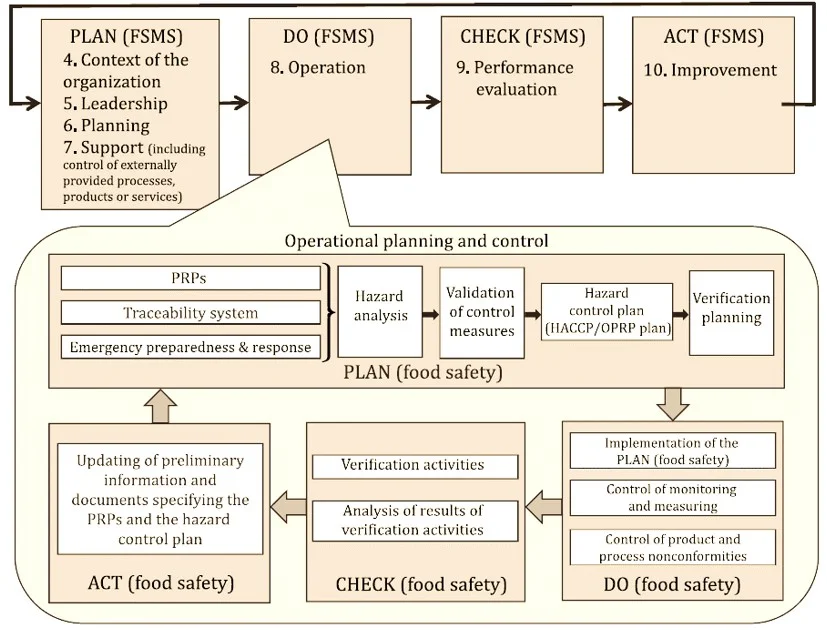
ISO 22000 now adopts Annex SL’s high-level structure (HLS), which provides a unified framework for all ISO management system standards. This modernized approach offers three key advantages. First, it ensures consistency across different standards. Second, it enables full alignment between various management systems. Third, it harmonizes sub-clauses and terminology across all food safety management standards. As a result, organizations can achieve smooth integration while reducing compliance challenges. Additionally, this standardized structure allows businesses to implement, maintain, and audit multiple management systems—including food safety—more efficiently than before.
Applicable Clauses for Implementation
- Context of Organization
- Leadership
- Planning
- Support
- Operation
- Perfomance Evaluation
- Improvement
What Is the ISO 22000 Certification Process, Timeline, and Cost?
Project phase | Main activities | Tentative timeline | Tentative price in PKR |
Initial gap assessment | Site review, gap report, project plan | 3 to 5 working days | PKR 40,000 to PKR 90,000 |
System development | Documentation, hazard analysis, prerequisite programmes | 3 to 6 weeks | PKR 150,000 to PKR 350,000 |
Training and implementation | Staff training, record use, process control support | 2 to 4 weeks | PKR 80,000 to PKR 200,000 |
Internal audit and management review | Audit, corrective actions, leadership review | 1 to 2 weeks | PKR 50,000 to PKR 120,000 |
Certification audit | Independent Stage 1 and Stage 2 audit | 2 to 4 weeks | PKR 180,000 to PKR 500,000 |
Total estimated project | Implementation and certification audit | 8 to 16 weeks | PKR 500,000 to PKR 1,260,000 |
The prices above are planning estimates, not fixed quotations. Actual cost depends on the number of sites, employee count, product risk, process complexity, audit days, travel, certification body selected, and the condition of the existing system. Annual surveillance audit costs and recertification costs should also be budgeted separately.
Why Should Your Business Pursue ISO 22000 Certification Now?
ISO 22000 Certification in pakistan is a strategic investment for food businesses that want to protect consumers, improve process control, and grow with confidence. A well designed food safety management system helps a business move beyond reactive inspections and build daily control over its real risks.
With structured guidance from Global Standards Certification, organizations can develop the right system, train their people, prepare for audit, and maintain certification with less confusion and less avoidable delay. The outcome is not only a certificate. It is a stronger food safety culture that customers, regulators, and business partners can trust.
Phone:
General Landline: +92-21-32534937
Business Development: +92-306-2708496
Operations & Support: +92-308-2255440
Emails:
info@globalstandards.com.pk
business.dev@globalstandards.com.pk
training@globalstandards.com.pk
operation@globalstandards.com.pk
jobs@globalstandards.com.pk