
ISO 14001 CERTIFICATION
ISO 14001 Environment Management System Certification, Training & Auditing
ISO 14001 Certification gives organizations a recognized system to control environmental impacts, meet compliance duties, reduce waste, improve resource use, and strengthen trust with customers, regulators, and international buyers.
Environmental performance now affects market access, operating cost, legal exposure, and brand credibility. Organizations in Pakistan that export goods, supply large companies, operate industrial facilities, or work in regulated sectors need a reliable way to manage their environmental responsibilities. ISO 14001 provides that structure through an Environmental Management System, or EMS.
The standard helps an organization identify the environmental effects of its work and apply controls that fit its actual operations. These effects may include waste generation, wastewater, air emissions, energy use, water use, chemical handling, packaging, transport, noise, and emergency events. It also requires leaders to review performance and support continual improvement.
Global Standards Certification supports organizations from the first gap assessment through implementation, training, internal auditing, and certification readiness. The fastest and simplest practical route is not generic paperwork. It is a focused system based on the organization’s real risks, people, legal duties, and business goals.

Why ISO 14001 Matters
ISO 14001 is an internationally recognized environmental management standard. It does not set one fixed environmental target for every business. Instead, it requires each organization to understand its own environmental aspects, compliance obligations, risks, and improvement opportunities.
A well-managed EMS helps leaders move environmental work from informal practice into a controlled business process. Responsibilities become clear. Staff know how to handle waste, chemicals, emergencies, and records. Environmental goals can be measured. Management can see where money, energy, water, or materials are being lost.
The standard is especially relevant for textile processing, food manufacturing, energy generation, engineering, logistics, construction, health care, chemicals, and export-focused businesses. It can also help service organizations manage office energy, procurement, electronic waste, travel, and supplier impacts.
What is the Core Requirements for a Strong Environmental Management System
An effective ISO 14001 system begins with a clear review of the organization’s activities and their environmental effects. This review should identify normal operations, unusual conditions, and emergency situations.
The system should then cover the following areas:
- Environmental policy and leadership commitment.
- Identification of environmental aspects and significant impacts.
- Legal, regulatory, customer, and other compliance obligations.
- Environmental objectives, targets, and action plans.
- Employee competence, awareness, and documented responsibilities.
- Operational controls for waste, emissions, energy, water, chemicals, and suppliers.
- Emergency preparedness and response.
- Monitoring, measurement, internal audits, corrective actions, and management review.
Documentation matters, but documents alone do not create compliance. The strongest systems are easy for employees to use and are built into day-to-day work. For example, a waste-control procedure should match the actual way waste is collected, labelled, stored, and sent to an approved disposal provider.
Global Standards Certification: Full-Scope Support
Global Standards Certification can fully assist an organization in building and preparing an ISO 14001 management system. The service begins with an initial self-assessment or gap analysis. This step compares current practices with the requirements of the standard and identifies the most urgent gaps.
Following the assessment, the team can support policy development, environmental-aspect analysis, legal registers, procedures, staff training, internal audits, corrective-action plans, and management-review preparation. This approach helps organizations avoid wasted effort on unnecessary documents and focus on controls that matter.
After receiving the self-assessment results, Global Standards Certification shall contact the organization to share the findings, explain the priority gaps, and provide further assistance on the next steps. This allows management to make an informed decision on scope, timeline, required resources, and certification readiness.
A credible consultant can prepare an organization efficiently, but the final certification decision must always be made by an independent certification body after its audit. This protects the value and integrity of the certificate.
Global Standards Certification Efforts and Reported Sector Results
Global Standards Certification reports successful completion of its supported management-system engagements across the sectors it serves. Certification itself remains subject to the independent certification body’s audit and decision. The following table outlines the practical effort used to improve client readiness and environmental performance.
Sector and organization | Global Standards Certification effort | Reported result |
Textile sector: Nazeer Dyeing & Bleaching | Reviewed environmental-system practices, provided employee education, issued implementation guidelines, and supported management-system improvement. | The organization improved its environmental system and employee competence, with stronger controls intended to generate less waste. |
Energy sector: Sindh Nooriabad Power Company | Delivered QHSE services, environmental policies, staff training, and leadership guidance over four months. | The organization reported improvement of up to 45% against its emissions through environment-friendly policies and training. |
Food manufacturing sector: Viscolloids Industries | Provided QHSE consultation, employee training, internal auditing, and corrective-action support. | The organization reported up to 35% progressive improvement in managing waste generation, energy consumption, and related environmental issues. |
All supported sectors | Conducted gap assessments, created practical controls, trained teams, reviewed performance, and prepared organizations for independent audits. | A structured route to certification readiness, improved competence, and stronger environmental management practices. |
Benefits of ISO 14001 Certification
The main benefit is control. Organizations can identify where environmental risk exists and act before it turns into a legal issue, customer complaint, production loss, or reputation problem.
ISO 14001 can also reduce avoidable costs. Better segregation can lower waste disposal expenses. Monitoring energy and water use can reveal losses. Clear chemical controls can reduce spills and unsafe handling. Defined responsibilities can prevent missed inspections and incomplete records.
For commercial teams, certification can improve supplier credibility. Buyers often want evidence that their suppliers manage environmental impacts in a formal way. An ISO 14001 certificate can strengthen tender submissions, customer confidence, export opportunities, and vendor registration.
For employees, the standard creates clarity. Training helps staff understand why their actions matter and what they must do. This supports safer handling, cleaner workplaces, better reporting, and more consistent environmental performance.
what is the New Methodology Of PDCA Model
ISO 14001 now uses Annex SL’s high-level structure (HLS), which establishes a unified framework for all ISO management systems. As a result, this innovative approach delivers three key benefits similar to other standards in the ISO family. First, it maintains consistency across standards. Second, it fully aligns different management systems. Third, it standardizes sub-clauses and terminology across all standards for environment certification. Because of this, organizations achieve seamless integration while lowering compliance complexity. Furthermore, this common structure helps businesses implement, maintain, and audit multiple management systems more efficiently than ever before.
Applicable Clauses for the Implementation
- Context of Organization
- Leadership
- Planning
- Support
- Operation
- Perfomance Evaluation
- Improvement
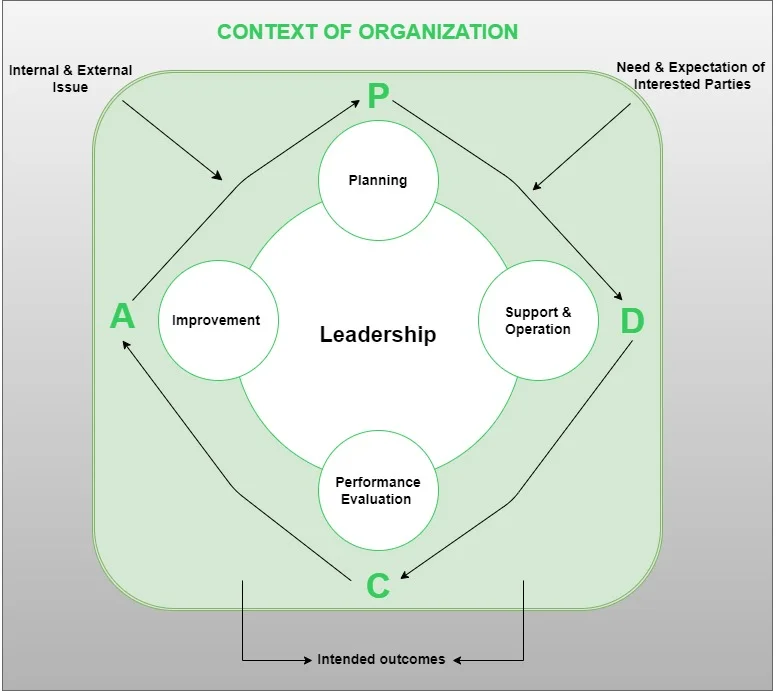
What is the Indicative Timeline and Pricing for ISO 14001 Certification
The following figures are tentative planning estimates in Pakistani Rupees. Final pricing depends on company size, number of sites, employee count, environmental risk, current documentation, travel, and the certification body selected.
Organization profile | Tentative implementation timeline | Global Standards Certification support | Estimated external certification audit | Indicative total project range |
Small service or low-risk organization, one site | 2–4 weeks | PKR 80,000–90,000 | PKR 80,000–100,000 | PKR 120,000–190,000 |
Medium manufacturing or export organization, one site | 5–6 weeks | PKR 100,000–150,000 | PKR 100,000–120,000 | PKR 200,000–270,000 |
Large industrial or high-risk organization, multiple functions or sites | 6–7 weeks | PKR 180,000–200,000 | PKR 200,000–250,000 | PKR 380,000–450,000 |
Disclaimer: This information is not fixed and varies subject to the company’s actual status of size, volume, and scope of business.
Closing Perspective
ISO 14001 is most valuable when it becomes part of business management rather than a certificate displayed on a wall. Organizations that begin with a realistic assessment, train their people, measure what matters, and correct weaknesses can build a system that supports compliance, efficiency, and long-term growth.
Global Standards Certification offers a practical route for organizations that want expert guidance, clear documentation, capable employees, and a faster path to audit readiness. The right implementation can turn environmental responsibility into a measurable business advantage.
FAQ’s
Q1: What is ISO 14001 Certification?
A: ISO 14001 is an internationally recognized Environmental Management System (EMS) standard. It provides organizations with a structured framework to control environmental impacts, fulfill compliance duties, reduce waste, optimize resource use, and enhance trust with customers, regulators, and international buyers.
Q2: Why is ISO 14001 important for organizations in Pakistan?
A: Environmental performance directly impacts market access, operating costs, legal exposure, and brand credibility. For Pakistani businesses especially exporters, industrial operators, and suppliers to large enterprises ISO 14001 offers a reliable framework to handle environmental responsibilities and meet regulatory or international trade requirements.
Q3: What core requirements are needed for a strong Environmental Management System?
A: A strong EMS requires leadership commitment, an environmental policy, identification of environmental aspects and significant impacts, legal and compliance management, environmental objectives and action plans, employee competence and awareness, operational controls (for waste, emissions, energy, chemicals), emergency preparedness, internal auditing, and periodic management reviews.
Q4: How does ISO 14001 integrate with other ISO standards using the PDCA model?
A: ISO 14001 uses Annex SL’s High-Level Structure (HLS), aligning Clauses 4 through 10 (Context, Leadership, Planning, Support, Operation, Performance Evaluation, and Improvement). This standardized framework ensures seamless integration with other management systems like ISO 9001 and ISO 45001.
Q5: What services does Global Standards Certification provide for ISO 14001?
A: Global Standards Certification offers full-scope support including initial gap analysis, policy development, environmental-aspect analysis, legal registers creation, operational procedures, staff training, internal audits, corrective-action planning, and management review preparation.
Q6: How long does it take to implement ISO 14001 and what are the estimated costs in Pakistan?
A: Timelines and indicative total costs (including consultancy and external audit fees) in PKR are:
- Small service / low-risk organizations: 6–8 weeks (PKR 380,000 – 650,000)
- Medium manufacturing / export organizations: 10–14 weeks (PKR 800,000 – 1,350,000)
- Large industrial / high-risk multi-site organizations: 16–24 weeks (PKR 1,500,000 – 2,450,000)
Q7: Does Global Standards Certification directly issue the ISO 14001 certificate?
A: No. Global Standards Certification provides consulting, implementation guidance, and audit readiness support. The final certification decision must always be made by an independent certification body following an audit to maintain certificate integrity.
Phone:
General Landline: +92-21-32534937
Business Development: +92-306-2708496
Operations & Support: +92-308-2255440
Emails:
info@globalstandards.com.pk
business.dev@globalstandards.com.pk
training@globalstandards.com.pk
operation@globalstandards.com.pk
jobs@globalstandards.com.pk