
FSSC 22000 CERTIFICATION
FSSC 22000 Certification Services Through Global Standards
FSSC 22000 Certification stands as the ultimate Global Food Safety Initiative (GFSI) benchmarked management system that integrates the ISO 22000 structure, sector-specific Prerequisite Programs (PRPs), and targeted FSSC requirements. This certification equips food manufacturing, packaging, and agricultural processing facilities to guarantee complete supply chain integrity, eliminate biological or chemical hazards, and secure seamless access to high-value domestic and international retail markets.
Navigating the compliance pathway requires precise structural execution, gap identification, documentation alignment, and rigorous internal audit protocols. Partnering with expert advisory solutions like Global Standards allows processing facilities to systematically transition through stage-1 and stage-2 certification audits with maximum operational efficiency, absolute zero-failure risk, and fully streamlined resource allocation.
Key Performance Identifiers
- GFSI Recognition: Unlocks tier-1 international retail and export supply chain network access.
- Core Integrated Architecture: Built upon ISO 22000, sector-specific PRPs, and FSSC Additional Requirements.
- Risk Mitigation Standards: Systematic HACCP integration alongside active Food Defense and Food Fraud prevention strategies.
- Corporate Reliability Assurance: Proves strict compliance with dynamic international food safety regulations and consumer protection mandates.

What Is FSSC 22000 Certification and Why Is It Essential for Your Business?
FSSC 22000 Certification represents a complete Food Safety Management System (FSMS) designed to deliver operational risk control, regulatory compliance, and commercial trust throughout the entire food value chain. Based on the high-level ISO structure, it harmonizes quality management procedures with critical food safety protocols. This makes it a requirement for food producers aiming to supply global supermarkets, hypermarkets, and international brands.
Securing certification protects your brand against product recalls, operational contamination, and major financial penalties. It verifies that your processing facilities meet world-class hygiene, traceability, and hazard management standards, giving your business a sustainable competitive edge.
What Key Components Make Up the FSSC 22000 Standard Scheme?
The framework consists of three mandatory core elements that create a complete defense system for food operations:
- ISO 22000 FSMS Standard: Provides the management system architecture, risk management frameworks, interactive communication channels, and continuous improvement cycles (Plan-Do-Check-Act).
- Sector-Specific Prerequisite Programs (PRPs): Mandates physical hygiene standards, equipment sanitization, pest control protocols, personal hygiene, and facility maintenance detailed in ISO/TS 22002 series standards.
- FSSC Additional Requirements: Specifies stringent controls for food safety culture, equipment design, food loss and waste management, allergen control, food defense, and food fraud mitigation.
How Does Global Standards Simplify the Road to Full Certification?
Achieving FSSC 22000 Certification can seem complex, but Global Standards provides a direct path to compliance. By handling technical documentation, training internal teams, and conducting pre-assessment audits, Global Standards removes administrative friction and prepares your organization for certification.
Their certified lead auditors work alongside your operational team to design tailored workflows that fit your plant’s existing machinery and process flow without causing production bottlenecks.
| Implementation Phase | Action Taken by Global Standards | Direct Benefit to Your Organization |
| 1. Diagnostic Gap Assessment | Full facility review against FSSC standards to pinpoint compliance shortfalls. | Clear visual roadmap identifying necessary operational upgrades. |
| 2. System Documentation & Design | Custom drafting of HACCP plans, SOPs, PRP manuals, and food defense protocols. | Audit-ready documentation aligned with daily operations. |
| 3. Workforce Capability Building | Targeted hands-on training for operators, food safety teams, and internal auditors. | Strong internal food safety culture across all plant levels. |
| 4. Pre-Audit Verification | Mock audit simulations led by senior lead auditors to test system compliance. | Eliminates non-conformities before the final assessment. |
| 5. Audit Execution Support | End-to-end support during Stage 1 and Stage 2 certification body audits. | High first-time pass rates with zero major non-conformities. |
What Sector-Wide Results Has Global Standards Achieved?
Global Standards delivers consistent success rates across diverse food and beverage operational sectors.
| Food Industry Sector | Scope of Support Offered | Result & Success Rate |
| Food & Beverage Manufacturing | Processing lines, continuous thermal treatment, thermal preservation, and packaging hygiene controls. | 100% Audit Success Pass Rate across high-throughput production lines. |
| Food Packaging Material Production | Flexographic printing, polymer extrusion, paperboard manufacturing, and chemical migration controls. | 100% Audit Success Pass Rate with zero high-risk migration non-conformities. |
| Agricultural & Plant Processing | Sorting, washing, cold-storage management, raw material handling, and post-harvest sanitation. | 100% Audit Success Pass Rate for major agricultural exporters. |
| Catering & Central Kitchens | Bulk food processing, cold-chain distribution management, and thermal holding validation. | 100% Audit Success Pass Rate for commercial food service providers. |
Client Case Studies: Proven Operational Impact & System Enhancement
| Client Name | Industry / Sector | Primary Challenges | Key Interventions by Global Standards | Measurable Impact & Timeline |
|---|---|---|---|---|
| A & Y Food Industries (Pvt) Ltd. | Food Manufacturing | Process non-standardization and compliance gaps with international food safety regulations. | • Customized FSSC 22000 manuals and policy development. • Workforce capability building and implementation training. • Comprehensive internal audit execution and process refinement. | 50% Improvement in food safety management system within months; enhanced team compliance confidence and risk reduction. |
| Viscolloids Industries | Food Sector / Exports | Urgent requirement for rapid, sustainable operational transformation to meet export market demands. | • Executive leadership training aligned with FSSC 22000 standards. • Hands-on consultation for workflow and documentation overhaul. • Internal compliance audits for continuous adherence. | 60% Transformation in food safety processes achieved within 2–3 months with minimal operational downtime. |
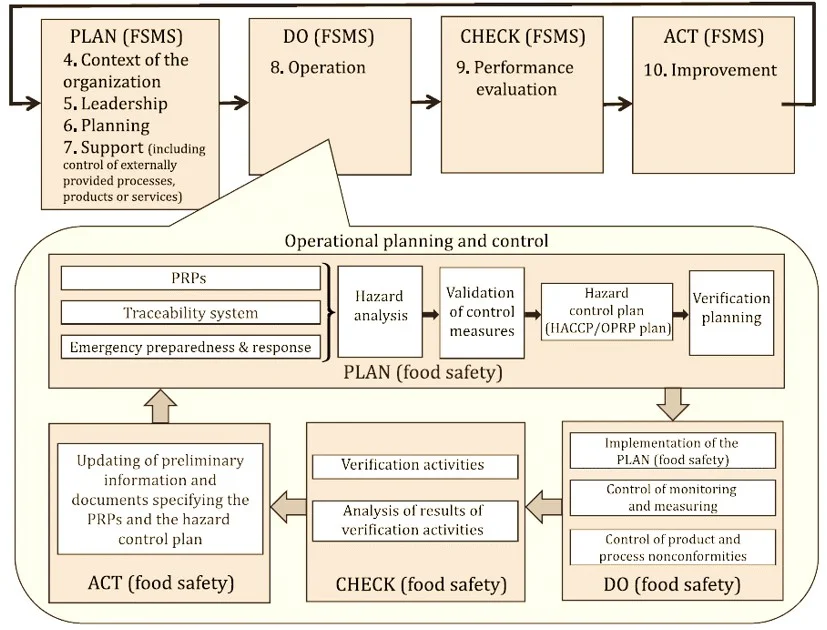
New Methodology Of PDCA Model
Structure
FSSC 22000 follows the model of ISO 22000 standard which follows Annex SL’s high-level structure (HLS), which provides a unified framework for all ISO management system standards. This modernized approach offers three key advantages. First, it ensures consistency across different standards. Second, it enables full alignment between various management systems. Third, it harmonizes sub-clauses and terminology across all food safety management standards. As a result, organizations can achieve smooth integration while reducing compliance challenges. Additionally, this standardized structure allows businesses to implement, maintain, and audit multiple management systems—including food safety—more efficiently than before.
Applicable Clauses for Implementation
- Context of Organization
- Leadership
- Planning
- Support
- Operation
- Perfomance Evaluation
- Improvement
What Are the Estimated Timelines and Project Costs?
Global Standards offers economical project pricing structure tailored for local and regional markets, delivering top-tier technical guidance at competitive rates.
| Organization Size / Scope | Operational Complexity | Project Duration | Estimated Investment (PKR) |
| Small-Scale Facility (1 to 25 FTEs) | Single product line, standard prerequisite programs | 6 to 8 Weeks | PKR 250,000 to PKR 400,000 |
| Medium-Scale Facility (26 to 100 FTEs) | Multiple product lines, complex processing environments | 10 to 14 Weeks | PKR 450,000 to PKR 750,000 |
| Large Industrial Facility (100+ FTEs) | Multi-site facilities, automated lines, high export volume | 16 to 24 Weeks | PKR 800,000 to PKR 1,400,000 |
Disclaimer: The exact prices are subject to the size, volume and scope of business of organization. These are just illustrative prices.
Why Rely on the Expertise of Global Standards Auditors?
Global Standards works with senior lead auditors and IRCA-accredited technical specialists who understand international accreditation bodies inside and out. Their team brings real-world auditing experience across agricultural, chemical, packaging, and high-risk food manufacturing environments.
Rather than burdening your team with rigid, theoretical systems, Global Standards builds lean, compliant frameworks. They help your staff master corrective actions, internal audits, and process validations, ensuring your organization maintains continuous compliance year after year.
What Are the Business Benefits of Obtaining FSSC Certification?
Achieving FSSC 22000 Certification delivers tangible operational and financial advantages:
- Global Market Expansion: Meets mandatory vendor onboarding standards for major international retailers, food service networks, and global importers.
- Reduced Audit Fatigue: Satisfies multiple client and regulatory standards with a single, universally accepted GFSI certification audit.
- Streamlined Operations: Identifies process inefficiencies early, cutting down raw material waste, batch rejections, and product rework.
- Stronger Consumer Trust: Shows a clear commitment to food safety and hygiene, elevating your brand’s reputation worldwide.
FAQ’s
What is the primary difference between ISO 22000 and FSSC 22000?
ISO 22000 is a standard food safety management framework, but it is not formally benchmarked by the Global Food Safety Initiative (GFSI). FSSC 22000 combines ISO 22000 with sector-specific PRPs and additional FSSC requirements to secure full GFSI recognition, which international buyers often require.
How long remains valid the issued certificate once achieved?
The certification operates on a 3-year cycle. To maintain valid status, certified facilities must undergo annual surveillance audits during years one and two, followed by a formal recertification audit prior to the end of the third year.
Can a small processing unit successfully achieve this certification?
Yes, businesses of any size can earn certification. The standard scales to match the size, scope, and operational complexity of your facility. Global Standards helps small businesses implement lean systems that meet all compliance requirements without unnecessary overhead.
What happens if non-conformities are identified during the audit?
If an auditor identifies non-conformities during Stage 2, your organization is given a standard window (typically 30 to 90 days depending on severity) to submit root-cause analyses, evidence of correction, and preventive action plans. Global Standards assists you through this phase to ensure all findings are cleared quickly.
Phone:
General Landline: +92-21-32534937
Business Development: +92-306-2708496
Operations & Support: +92-308-2255440
Emails:
info@globalstandards.com.pk
business.dev@globalstandards.com.pk
training@globalstandards.com.pk
operation@globalstandards.com.pk
jobs@globalstandards.com.pk